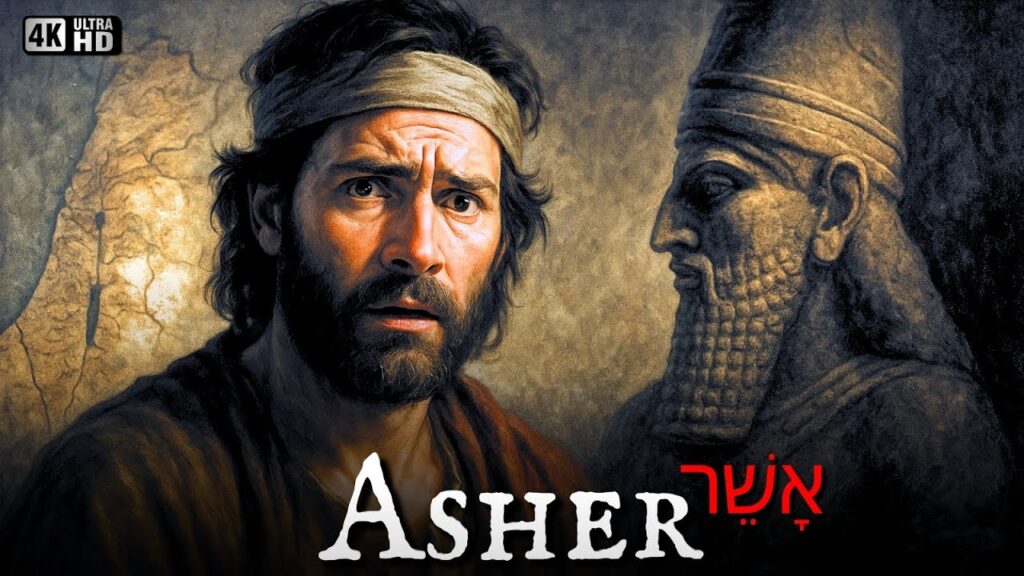
This is the son of Jacob, who may have been named after a pagan god, lived outside the land of Israel, stayed away from war, was forgotten in most of the Bible, and yet appears among the 144,000 sealed in Revelation. How is that even possible? Today, you will uncover the real story behind Asher, a journey involving a controversial origin, strange alliances, and a prophetic return that almost no one notices. Genesis 30:13 records an almost poetic moment. And Leah said, "Happy am I, for the daughters will call me blessed." And she called his name Asher. At first glance, the birth of Asher, son of Jacob by Zilpa, Leah's handmmaid, seems to bring nothing but joy, just as his name suggests. Asher literally means happy or blessed. But is that all there is? Or is there a hidden meaning long overlooked that could change how we view this character? Notice the depth of these words. The name Asher, written in Hebrew as Asher, follows a grammatical pattern commonly found in names with spiritual intent. However, what few notice and is rarely addressed in Christian videos is that this name has an identical sound to a Mesopotamian pagan deity, Ashure, the national god of Assyria. Ashure wasn't just one god among many. He was the very center of Assyrian religion and identity, the emblem of a civilization that would later become a fierce enemy of Israel. Now, think about it. Why would a son of Jacob, the patriarch of the covenant, have a name so close to that of a pagan god? Could this be a clue that Hebrew culture at the time still carried remnants or even contamination from the religious traditions of the lands they came from? Remember, Jacob still lived under strong influence from the customs of Haran, where names, gods, and traditions were deeply intertwined. Jacob's own father-in-law, Laban, was an idoltor who possessed teraphim, household gods. Genesis 31:30. Could it be that Asher's name was born in a context far more complex than we usually imagine? Fascinating, isn't it? This seemingly technical detail, the origin of Asher's name, lies at the center of a heated debate among biblical linguists and archaeological scholars. Some argue that the name Asher has no connection to Ashure, claiming the Hebrew root Asher, happy is sufficient to explain it. Others, however, point out that tribal and regional names of that era often absorbed elements from neighboring cultures, whether through trade, intermarriage, or mere survival. As academic as this may seem, the debate is crucial to understanding what was at stake in the formation of the 12 tribes of Israel. A name carries a message. And if Asher's name represents a link, even a faint one, to foreign deities, then this tribe's very birth is marked by spiritual tension, blessing, or synretatism, covenant, or compromise. And here's something few notice. No other son of Jacob bears a name with such symbolic ambiguity. Judah represents praise. Joseph, increase. Levi, priestly union. But Asher carries a foreign echo. Had you ever considered this, that one of Jacob's sons, from whom the 12 tribes would descend, may have received a name that sounds like a pagan god, a name that, even though rich in Hebrew, meaning whispers between the lines, the memory of an idolatrous empire, and this is no small detail. Throughout the history of the tribe of Asher, we will see this tension manifest in actions, alliances, and spiritual choices. The issue of the name then is not just linguistic. It is prophetic. Now that you've seen how Ash's name may carry more than just joy, we must face a new layer of mystery. One that's not found in genealogies, but in ancient Egyptian stone. Yes, we are entering the realm of biblical archaeology and what was discovered there may change everything we think we know about the traditional biblical timeline. Researchers discovered an Egyptian inscription dated to the 13th century BC, a time of strong ferionic control in which the name Asher appears as a reference to a people, a people already established in the land of Canaan. Now think carefully. According to the book of Joshua, the conquest of Canaan happened after the Exodus in the 15th century BC. If Asher appears in Egyptian records before the conquest, we are faced with a chronological dilemma that challenges the literal interpretation held by many conservative commentators. Could this Asher in the inscriptions be the same people from the tribe of Asher, one of Jacob's sons? or was it simply a group with a similar name? Some scholars say yes, that the tribe of Asher was already in the land even before Joshua's conquest. This would suggest an earlier, perhaps parallel Israelite presence in Canaan. Others propose that the name was of Phoenician origin and only later was the tribe integrated into Israel's identity. Do you see the impact of this? This single piece of evidence reshapes how we understand the entry of the 12 tribes into the promised land. And once again, Asher stands at the center of the controversy. Now, let's go beyond the surface. If the tribe of Asher was already settled in the north near the coast and trade routes, as we'll see in the next topic, this may suggest that they entered through a different route, or even that they did not leave Egypt with Moses at all, but rather settled separately in a different phase of history, a kind of peaceful or strategic infiltration distinct from the military conquest. This opens the door to deep debates within biblical textual criticism and sheds light on the internal diversity of Israel's people. Not all tribes had the same geographic or sociological origin. Some carry elements of cultural assimilation, others of radical rupture. And the tribe of Asher, with its ambiguous name and possible early presence in Canaan, seems to stand at the intersection between the Hebrew world and the Canaanite Phoenician world. Had you ever heard of this in common sermons or Bible studies? Probably not. And that's exactly why this archaeological detail is so vital. It shows how the Bible, history, and Christian esquetology are woven together with layers that demand both spiritual and intellectual excavation. The story of Asher is not limited to Jacob's genealogy. It is a living archaeological trail that forces us to reconsider assumptions and dive into what the Bible hints between the lines. And don't worry, this doesn't weaken faith. On the contrary, it reveals the depth with which God writes his story, even using tribes that no one expected. And this is where the next turning point comes in. Where Asher settled, the neighbors they lived with, and the spiritual choices the tribe made. If there is one tribe that took a radically different path from the others, it was Asher. While the tribes of Judah, Ephraim, and Manasseh were engaged in wars, conquests, and spiritual battles for possession of the land, the tribe of Asher made another choice. It preferred the coastal zone. And more than that, it embraced a commercial vocation alongside the Phoenetians, a people known for their wealth, sophistication, and idolatry. This is not a random deduction. In Judges 5:17, when Deborah and Barack call the tribes to fight against Israel's oppressors, the text issues a rebuke. Asher continued on the seashore and abodeed in his breaches. Do you see the contrast? While the sons of Jacob were facing armed enemies, the tribe of Asher was sitting passive watching the sea. The image is almost cinematic. God's people at war and Asher with folded arms by the shores of the Mediterranean. But this verse is more than geography. It is a spiritual accusation. In practice, Asher opted for commercial alliances with the Phoenetians, renowned sailors who dominated the trade of dyes, metals, and spices. It was a profitable relationship financially, but spiritually it came at a high cost. The Phoenetians were not just merchants. They were polytheists, worshippers of Baal and Ashtarth, a culture completely opposed to the faith of Israel. And here we find a key aspect of Asher's tribal identity. His inheritance described in Deuteronomy 33:24-25 is dipping his foot in oil, a symbol of abundance, prosperity, and anointing. But over time, that anointing became complacency. Ancient trade brought wealth, but it weakened their sense of mission. The tribe of Asher became prosperous but passive, anointed but absent from the battlefield, rich but silent. Sound familiar? How many today live by this same pattern? Rich in blessings but poor in spiritual courage. Asher is a mirror and a warning to all who choose the comfort of the coast over obedience in the war zone. And there's more. The coexistence with the Phoenetians led to a dilution of tribal culture, creating a gray area between what was Israelite and what was foreign. That's why the tribe of Asher is one of the least mentioned in the entire biblical narrative. It vanishes from wars, from deeds, from psalms, and from prophets. They prospered but drifted away. They lived but left no solid spiritual legacy. On the map of the tribes of Israel, Asher is there up north between Ty and Sidon, surrounded by Phoenician culture. But on the spiritual maps, Asher begins to disappear. Their absence in war was not merely a military detail. It was a statement of priorities, and God saw it. But the question still echoes. Was Ash's silence the end? Or could there still be a spark of redemption? After choosing the seashore and trade routes, the tribe of Asher slowly began to fade from the biblical narrative. And the most striking thing is that this didn't happen due to persecution or direct judgment. It happened through lost relevance. A tribe that was born under the blessing of anointing that received the promise of dipping his foot in oil simply vanished from Israel's central stage. In the book of Joshua chapters 19:24-31, Asher's territorial inheritance is clearly defined. It was a strategic region, fertile, coastal, rich in olive groves, perfect for a tribe to thrive. But what happened to Asher? Why, throughout Israel's journey, do we barely hear about them in crucial moments? The answer lies in what scholars call a weakened tribal identity. Asher did not participate in the great wars of unification. It produced no prominent judges. No kings came from Asher. No renowned priests were raised. Little by little, the tribe became invisible, fragmented among coastal cities and trading villages. Its close ties with the Phoenicians diluted its distinctly Israelite character. Geographical proximity turned into cultural fusion. And this progressive erasia raises a troubling yet necessary question. How could such a blessed tribe become so forgotten? The answer is not a lack of opportunity. It is the result of a mission in the face of God's call. The God of Israel blesses, but he also requires a response. Anointing comes with responsibility. The tribe of Asher received abundance, oil, children, prosperity, but failed to align itself with the central purpose of the divine plan. This silence in the sacred texts is a silence filled with spiritual weight. It's not just a historical footnote. It's a prophetic message. It's as if the Bible is saying, "Look at what happens when blessing is enjoyed without purpose. when prosperity is used for isolation instead of service. Have you noticed tribes like Judah and Levi appear repeatedly because they were always involved in God's redemptive plan. But Asher disappears. There's no mention of its leaders, no songs, no significant alliances. The tribe literally vanishes from the center of the story. And this leads us to one of the most powerful and saddest images in the Old Testament. A people present on the map, but absent from the move of God. The tribe of Asher became a fertile and comfortable territory, but spiritually neutral, a blessing wasted, a people forgotten. But was that really the end? Had God discarded Asher forever? Was the silence in scripture absolute? Or is there still a thread of continuity, however faint, ahead? This is where the story takes an unexpected turn. After centuries of silence, absence, and forgetfulness, the tribe of Asher reappears. And not on a battlefield, not in an Old Testament prophecy, but at the birth of the Messiah. Luke 2:36 introduces us to an extraordinary woman. And there was one Anna, a prophetess, the daughter of Fuel, of the tribe of Asher. She was of a great age. Yes, the forgotten tribe of Asher resurfaces as the origin of a prophetess who was in the temple at the exact moment baby Jesus was presented. Think about that. After so many years without direct mention after being relegated to the margins of history, Asher is there at the center of the greatest revelation of all time, the birth of the savior and more. Anna was not just any woman. She is described as a prophetess, a consecrated widow, a woman who never left the temple and served God with fastings and prayers day and night. In other words, she was a faithful spiritual active representative. The exact opposite of her tribe's reputation. Do you see the beauty in this? What was erased from history, God brought back through the spirit. What had been forgotten, God remembered at the birth of his son, the tribe of Asher, marked by silence and omission, now shines through the figure of a woman who recognized the Messiah while the religious leaders were still blind. And it doesn't stop there. Anna is part of a unique prophetic moment. While Simeon holds the child in his arms and prophesies, Anna spoke of him to all them that looked for redemption in Jerusalem. She becomes in practice one of the first evangelists of the New Testament. She didn't just see, she spoke, she proclaimed. This is far more than a casual mention. This is tribal redemption. God in his perfect plan, honors a lineage that seemed forgotten, giving it the privilege of announcing the redeemer. The prophetus Anna is the mustard seed sprouting from seemingly barren soil. She is heaven's answer to centuries of silence. It's as if the spirit were saying, "I do not forget the tribes I have anointed. Even if everyone else forgets, I remember." Revelation 7:6, a list that carries eternal weight, a roll call of names representing the sealed of God in the end times, 12,000 from each of the 12 tribes of Israel. And there, among Reuben, Naftali, and Simeon, there he is, Asher. Yes, the tribe of Asher, which began with an ambiguous name, flirted with pagan culture, traded with the Phoenicians, disappeared from the pages of the Old Testament, and reemerged quietly through the prophetesses Anna is counted among the 144,000 sealed of God in Revelation. Now, think carefully and reverently. How is it possible that a tribe with such a background marked by absence in war, silence in history, cultural dilution, and distance from Israel's spiritual center, could still be there, sealed at the end of the age? Is it a mistake, a coincidence, mere symbolism, or could it be grace? This is the most powerful point in the entire mystery. Asher's presence among the sealed forces us to acknowledge a profound theological truth. God does not choose based solely on historical performance, but according to the eternal plan he himself established. The prophetic seal is not a reward for human deeds. It is a mark of divine sovereignty. The list in Revelation 7 is no ordinary list. It represents those preserved in the midst of judgment. It is a symbol of purity, separation and divine ownership. And Asher is there. This means that God in his faithfulness restored what seemed lost. What historical records failed to celebrate? God sealed with his own seal. Had you ever considered this? A tribe barely mentioned in scripture. A tribe many might have considered forgotten, rejected, or even compromised, is chosen by God to stand among his own at the climax of redemptive history. This is no minor detail. It is tribal redemption in its purest form. It proves that God's covenant with the sons of Jacob remains despite failures, silences, and lapses. The tribe of Asher, with its name possibly linked to the pagan god Ashure, its fragmented territory, and its mixed Phoenician culture, ends its biblical journey with an honor that no earthly wealth could buy. The seal of God in the last days. This is the hidden message woven between the lines of Ash's story. A message for the end times. A message for the forgotten, for those who seem to be on the margins, for those overlooked by men, but seen by God. And with this revelation, we conclude the journey of the tribe of Asher, not as a footnote in scripture, but as a living witness of God's grace, prophetic mystery, and eternal faithfulness to his promise. If this video spoke to your heart, subscribe now and turn on notifications. Here on the Christian channel, everything is produced freely with the support of generous believers around the world just like you. Become a channel member, share this content, and don't forget to check the pinned comments for our handpicked book recommendations. Perfect for those who love going deeper into the scriptures.
Posted inBible stories
Who Was Asher? The Mysterious Son of Jacob Linked to Asshur, Exiled… Yet Among the 144,000!